Install PyRat
This section provides instructions on how to install the PyRat library and set up your workspace. This is essential to start developing games using the PyRat API.
Note
You can also find these installation instructions in the README file on the GitHub repository.
In short
If you are in a hurry, and already have uv installed, this is the whole installation:
uvx --python 3.13 --from pyrat-game pyrat-init
cd pyrat_workspace
uv run games/sample_game.py
The rest of this page explains each of these steps.
Prerequisites
This installation procedure assumes that you have basic knowledge about shell manipulation.
PyRat uses uv to manage Python and the libraries it needs. You do not need to install Python yourself: uv takes care of it, and downloads the version PyRat needs if your machine does not have it.
Finally, we will test PyRat installation using Visual Studio Code (VSCode), as this is the main tool we use in the associated course. Please make sure it is already installed, or install it from the official website. Note that you can use a different tool if you want, but we just provide indications for that one here.
Step 1 – Install uv
If uv is not installed on your machine yet, install it as follows.
curl -LsSf https://astral.sh/uv/install.sh | sh
curl -LsSf https://astral.sh/uv/install.sh | sh
powershell -ExecutionPolicy ByPass -c "irm https://astral.sh/uv/install.ps1 | iex"
Other installation methods are described in the uv documentation.
Important
Close and reopen your terminal after installing uv, otherwise the uv command will not be found.
You can then check that everything went well by running uv --version.
Step 2 – Setup your PyRat workspace
We are now going to create a workspace for PyRat. This is a directory that contains minimal working examples to get started, and in which PyRat is installed.
Open a terminal, and navigate (use the
cdcommand) to the directory where you want to create your PyRat workspace.Run the following command, which is the same on all systems:
uvx --python 3.13 --from pyrat-game pyrat-init
Note
PyRat cannot be used with Python 3.14 and later, as pygame (one of the libraries PyRat needs) cannot be installed with these versions.
This is why the command above asks uv to use Python 3.13.
You should see something like this:
Workspace created in /path/to/pyrat_workspace, as a uv project using Python >=3.12,<3.14
Git repository created for the workspace
Using CPython 3.13.13
Creating virtual environment at: .venv
Resolved 20 packages in 178ms
Installed 19 packages in 45ms
Virtual environment created, with PyRat installed in it
Your workspace is ready! You can now start coding your players and run games.
To run a game, go to the workspace using 'cd pyrat_workspace', then use for instance 'uv run games/sample_game.py'.
You should have a new directory called pyrat_workspace in the directory where you ran the command.
Tip
If you prefer another name, pass it to the command, as in uvx --python 3.13 --from pyrat-game pyrat-init my_project.
Here is what this directory contains:
pyrat_workspace
|_ games                   # The scripts that start a game
|_ players                 # The programs that control a character
|_ .venv                   # The virtual environment of the workspace, created by uv
|_ pyproject.toml          # The description of your project and of the libraries it needs
|_ uv.lock                 # The exact versions of the installed libraries
|_ README.md               # A description of the workspace
|_ .gitignore              # The files that Git should ignore
Important
PyRat installs a small file in the virtual environment of your workspace, which adds your workspace to the directories Python imports from.
This is what allows a script in games to import a player from players, as in from players.random1 import Random1.
Any directory you add to your workspace is importable the same way, with nothing to declare.
This file finds your workspace from the virtual environment it contains, rather than writing its path down, so you can rename or move your workspace with no command to run afterwards. It puts nothing in your workspace, which holds nothing but your programs and the files uv needs.
Step 3 – Check your installation
Now, we are going to verify that PyRat works properly.
Open a terminal, and navigate to your workspace using
cd pyrat_workspace.Run the sample game:
uv run games/sample_game.py
Open VSCode, and add your
pyrat_workspacedirectory in your VSCode workspace.Open the file
sample_game.pyin directorygames/.Make sure VSCode is using the interpreter located in the
.venvdirectory of your workspace.Run
sample_game.py.
In both cases, you should see something like this:
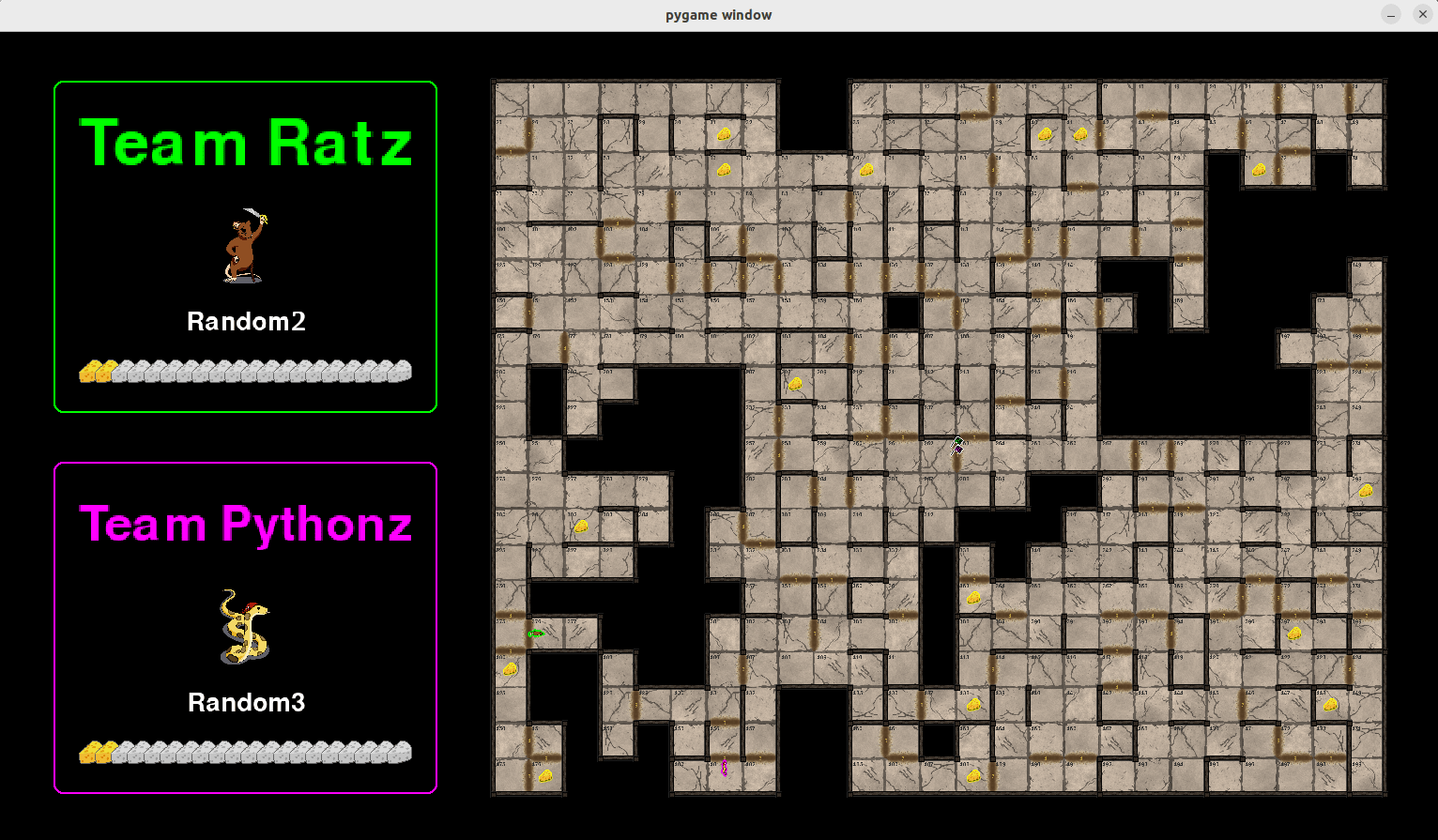
Have a look at the Quick Overview to understand what you are seeing, then follow The Random Programs to write your first player.
Add other libraries to your workspace
Your workspace is a uv project, so you can add any library you need to it.
To do so, run uv add from your workspace:
uv add numpy
The library is then available in your players and games, with no need to activate anything.
Rebuild your workspace
Your workspace describes everything it needs in its pyproject.toml and uv.lock files, so it can always be rebuilt.
Run this from the workspace, for instance after cloning it on another machine, or if one of its libraries goes missing:
uv sync
This installs again everything your workspace declares, in a virtual environment created for your machine.
Note
Renaming or moving your workspace needs nothing. Your workspace is found from the virtual environment it contains, so your programs keep importing each other wherever the workspace is.
Troubleshooting
A game cannot import one of my players
Your workspace has no virtual environment yet, which is the case when it was just cloned from a Git repository, as a .venv directory is never versioned.
Run uv sync from your workspace, as described in Rebuild your workspace.
Check also that you are running your program with the interpreter of your workspace, which is the one in its .venv directory.
In VSCode, this is the interpreter you select for the directory you opened.
The uv command is not found
Either uv is not installed (see Step 1), or your terminal was opened before installing it.
Close and reopen your terminal, then try uv --version again.
Something else goes wrong
Please check the existing GitHub issues first.
If the problem persists, you can add an issue of your own.
For students at IMT Atlantique, you can also ask your questions on the Discord server of the course.
Finally, you can contact Bastien Pasdeloup directly.